
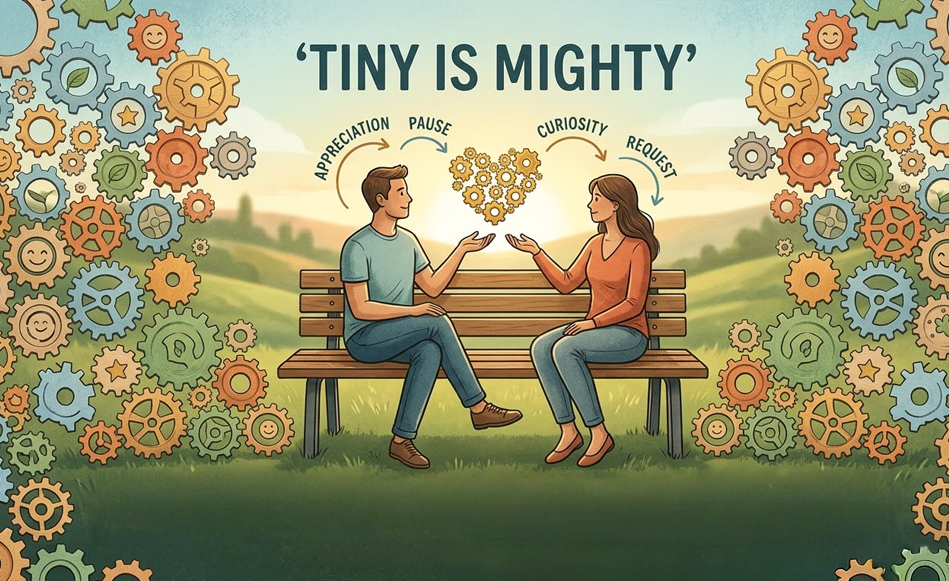
How Tiny Moments of Connection Can Change the Direction of a Relationship
by Craig Moorman, PhD, LPC | Clinical Director
When couples begin to struggle, many people assume the solution must be something big.
- We need a long talk.
- We need to fix everything.
- We need to figure out what’s wrong.
But here’s a question worth considering:
What if the health of a relationship changes not through one big conversation, but through very small moments repeated over time?
Most meaningful relationship change doesn’t happen through dramatic breakthroughs. It happens through tiny shifts in how two people show up with each other day after day.
As Vincent van Gogh once wrote,
“Great things are not done by impulse, but by a series of small things brought together.”
The nervous system in relationships
When conflict escalates, something important happens beneath the surface.
Our nervous systems begin to move into a defensive state. When that happens, the brain becomes less capable of curiosity, listening, and flexible thinking.
In other words, our ability to communicate drops right when communication is needed most.
Trying to solve everything in that moment can feel like trying to repair an airplane engine while it’s in turbulence.
Sometimes the wiser move is not to push harder, but to make the step smaller.
Tiny repairs
Instead of trying to repair the entire relationship in one conversation, start with small moments of reconnection.
- Pausing before responding in an argument
- Shifting your complaint to a request. “I would really like it if…”
- Saying one appreciative thing each day
- Asking a curious question instead of making an assumption
- Taking a five-minute walk together after dinner
- Offering a simple “I’m glad you’re here”
None of these things seem dramatic.
But relationships are built through patterns, and patterns change through small repeated actions.
Over time, small positive moments begin to soften tension and rebuild a sense of connection.
Lower the emotional cost
Many couples get stuck because the emotional cost of engagement feels too high.
If every attempt to talk feels like it could turn into an argument, the brain naturally begins to avoid those conversations.
The solution is not always to force deeper discussions.
Sometimes the solution is to lower the emotional cost of connection.
Start with moments that feel safe enough.
A brief check-in.
A shared laugh.
A small act of appreciation.
These moments may seem simple, but they help the nervous system settle and create an emotional environment where better conversations can eventually happen.
A Tiny Challenge for This Week
If you’d like to try the “Tiny is Mighty” principle in your relationship this week, here is one place to start.
For the next seven days, share one small appreciation with your partner each day.
Nothing elaborate. Nothing forced. Just something genuine.
- “Thanks for taking care of that today.”
- “I really enjoyed talking with you earlier.”
- “I appreciate how hard you work for our family.”
- “It meant a lot when you checked in with me.”
The goal isn’t perfection.
The goal is momentum.
Appreciation shifts the brain’s attention. Instead of scanning for what’s wrong or missing, it begins noticing what is working.
Over time, those small acknowledgments soften defensiveness, increase goodwill, and create more emotional safety between partners.
And safety is where better conversations eventually grow.
One sentence.
Once a day.
For one week.
You might be surprised how something tiny can begin to change the emotional tone of a relationship.
Because in relationships, just like in personal change…
Tiny is mighty.
Two Small Reflections
What is one appreciation you could share with your partner today?
What is one small moment this week where you could pause and notice something your partner is doing right?If the patterns in your relationship feel difficult to shift on your own, you don’t have to figure it out alone. Sometimes having a thoughtful third person in the room can help couples slow things down, understand each other more clearly, and begin making those small shifts that lead to meaningful change over time.
Our clinicians are always here if you’d like support taking those next steps together.