
By John Fletcher
A clinical perspective on helping children build lasting emotional security
It’s one of the most common and quietly distressing experiences for parents:
- Your child seems capable, bright, and growing in so many ways…
- And yet, something small can suddenly feel overwhelming.
- A school drop off. Sleeping alone. Being in another room.
You may find yourself wondering, “Why is this still so hard for them?”
In our work with families, we often see that childhood anxiety isn’t always about what’s happening right now. Sometimes, it reflects something more subtle, how a child has developed their sense of emotional security and independence over time.
A Helpful Clinical Lens: How Children Separate and Feel Safe
While every child is different, one useful way to understand this is through how children gradually learn to feel safe separate from their parents.
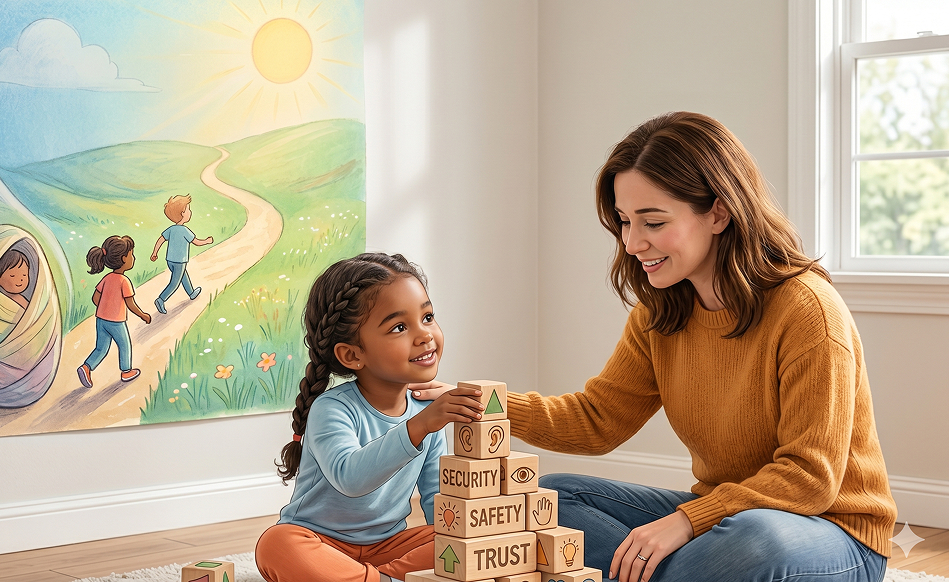
In early development, children tend to move through a progression that looks something like this:
- Touch. Very young children feel safest with physical closeness
- Sight. They can separate a bit, as long as they can see you
- Hearing. They tolerate more distance if they can hear you nearby
- Knowing. Eventually, they internalize safety and feel secure on their own
This isn’t a rigid formula, but rather a pattern we often observe clinically.
Most children move through these stages naturally. But sometimes, for a variety of reasons such as temperament, life stressors, transitions, or simply timing, a child may not fully settle into one of these stages before being pushed into the next.
When that happens, they may continue to grow intellectually and physically, while a part of their emotional system remains a bit younger.
When Anxiety Is a Signal, Not a Problem
Later on, this can show up in ways that feel confusing or frustrating:
- A child who resists going to school
- A need for excessive reassurance
- Difficulty being alone, even at an age where it seems unexpected
From this perspective, anxiety isn’t something to eliminate. It is communication.
It is the child’s way of saying, “I don’t quite feel secure yet.”
A Gentle, Practical Approach
When we work with families, one approach that can be very effective is to briefly return to the stage where the child feels most secure, and then help them move forward again, this time more fully.
For example:
- Spending time in the same room while a child plays or does homework
- Then gradually increasing distance while staying within earshot
- Eventually helping them build confidence being on their own
The key is not pushing independence too quickly, but building it step by step, in a way the child’s nervous system can truly absorb.
Often, when this foundation is strengthened, the anxiety begins to ease naturally.
A Reassuring Thought for Parents
If your child is struggling in this way, it does not mean something is wrong with them or with you.
More often, it simply means there is an opportunity to strengthen a developmental foundation that may have been missed or rushed.
And the encouraging part is this:
When we meet children where they are and guide them thoughtfully forward, they are remarkably capable of catching up and thriving.
If this perspective resonates with something you’re seeing in your child, we’re always here to help you think it through.
You don’t have to figure it out alone.