
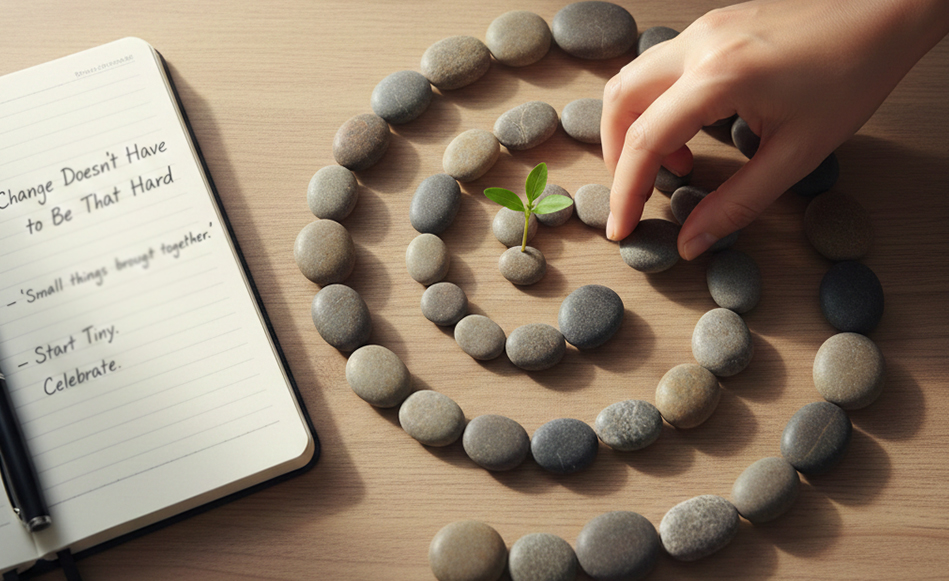
“Great things are not done by impulse, but by a series of small things brought together.” Vincent van Gogh
by Craig Moorman, PhD, LPC | Clinical Director
When people think about change, they often imagine something big, painful, or overwhelming.
- I need more discipline.
- I need to fix everything.
- I need to be a different person.
But meaningful change rarely starts that way.
Most lasting change begins quietly with a small shift in how we show up to one part of our lives we want to experience differently.
Start with one area you want to experience differently
Not what you want to fix but how you want to feel.
For example:
- “I want mornings to feel less rushed.”
- “I want to feel calmer in conflict.”
- “I want to be more present with the people I care about.”
Clarity reduces overwhelm.
Notice before you change
- Before trying to do anything differently, pause and observe.
- When does this pattern show up?
- What do you notice in your body?
- What do you usually do automatically?
Awareness creates choice.
A rule I often share with clients
Over the years, I’ve noticed a common moment where people get stuck when they hit an obstacle that feels too big to get around.
Here’s the rule I often share:
If you hit an obstacle you are having difficulty get around, make it smaller and go back at it.
Instead of pushing harder, scale it down.
Find your tolerance level… the place where effort feels challenging but doable.
That might mean:
- Shortening the task
- Slowing the pace
- Taking a brief pause and returning
- Practicing the skill in lower stress moments first
Progress does not come from forcing change.
It comes from working within your nervous system’s capacity.
Don’t give up adjust
When something feels too hard, it’s not a sign to quit.
It’s a sign to adjust the size of the step.
Small, repeated steps build confidence, momentum, and trust in yourself.
“Tiny” is Mighty
The Physics of Behavior: Why “Tiny” is Mighty Research from Dr. BJ Fogg at the Stanford Behavior Design Lab reveals that when change feels hard, we are usually relying on the wrong fuel. Fogg’s model (B=MAP) shows that behavior happens only when Motivation, Ability, and a Prompt converge.
Behavior (B) happens only when three things converge at the same moment:
- Motivation (Do you want to do it?)
- Ability (Can you do it easily?)
- Prompt (Is there a signal to do the behavior now?)
The problem is that we often rely on Motivation, which is fickle and exhaustible. The scientific solution is to ignore motivation and focus entirely on Ability, making the behavior so tiny it requires zero effort. Fogg famously coached people to establish a flossing habit by flossing just one tooth. Why? Because you can’t talk yourself out of a task that takes three seconds. But here is the secret ingredient most people miss: Celebration. Fogg calls it “Shine”, which is the act of instantly celebrating that tiny win (even with a simple mental “Yes!”). This releases dopamine, which is what actually wires the new habit into your brain. Emotions create habits, not repetition.
If you make the change “too small to fail” and celebrate it, consistency becomes automatic and sets you up for the next step.
The takeaway
Change doesn’t require a dramatic overhaul.
It requires attention, patience, and the willingness to meet yourself where you are.
Make it smaller.
Go back at it.
And keep going.
If the next step feels too big
And if the change you’re facing feels too big to take on alone, you don’t have to do it by yourself.
Reaching out for support is often the first and most meaningful step.
Our clinicians are here to help you clarify what you want, find your tolerance level, and take steady steps forward.